


 |
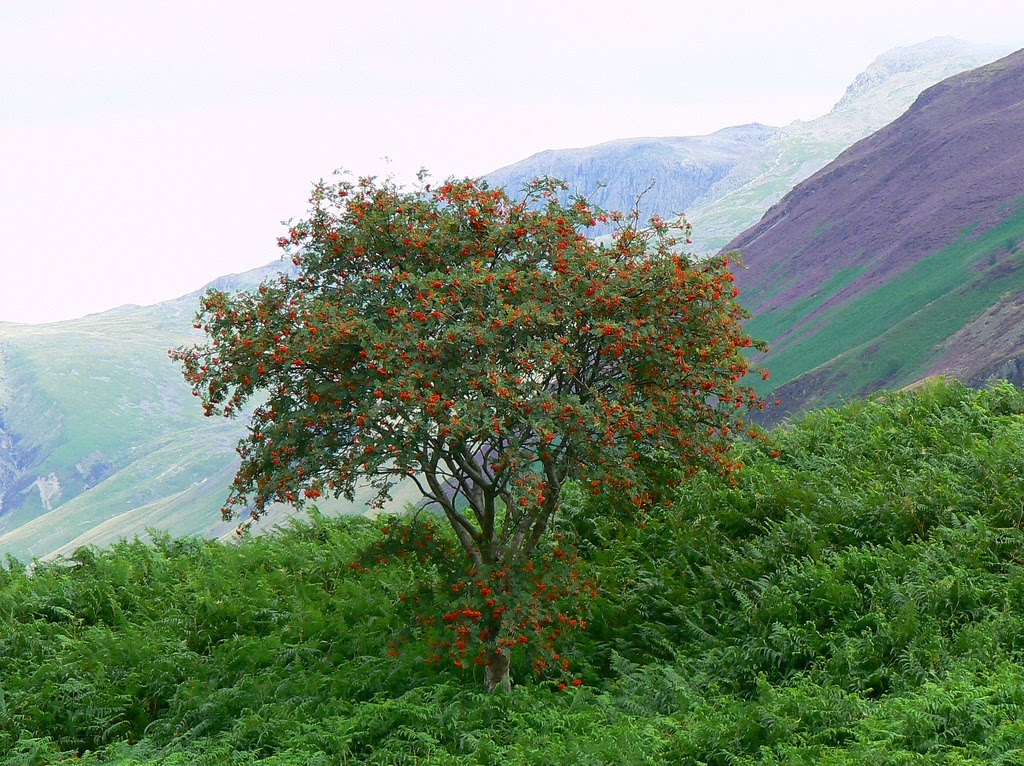
| A Rowan, (a.k.a. Wiggen Tree), growing on a mountainside. Source |
The Rowan, also known as the Mountain Ash or the Wiggen Tree, is a tree in the Rose family that does well in the cold and in high altitudes. The Rowan is occasionally found growing on larger trees; such specimens are known as "flying rowans". It has a light grayish bark that becomes rough as it matures and its leaves have a feather-like formation and are sometimes fuzzy. The fruit is red, soft, and juicy, and is an important source of food for many birds, who help spread its seeds through their droppings.
The name "Rowan" comes from the Common Germanic word raudnian, which means "becoming red". The name "Mountain Ash" comes from the trees resemblance to Ash Trees and the fact that it grows well in high altitudes. The word "wiggen" probably derived from the word wicken, (another name for the tree) which shares roots with the word "wicked" and derives from the Old English word wicca, which means "sorcerer". This word was applied to the tree because of the belief that it protected from witches and witchcraft.
In ancient times the Rowan was believed by many to have possess supernatural powers and it appears often in folklore and mythology, for example, in Greek mythology the tree is believed to have from the blood and feathers of an eagle.
The tree's wood is very strong and dense and thus is very useful for making wooden objects such as tools and walking sticks. Because of this, the wood was used by the ancient Norse to make rune staves and was also used by druids and later so-called sorcerers for staffs, wands, divining rods, and other such objects.
In addition to using the Rowan's sturdy wood, druids used the bark and berries to dye robes black for lunar ceremonies. In some traditions the leaves and fruit were also made into incense that was used for divination, and in parts of Scandinavia the condition of the tree was used to predict various things such as the weather and the harvest, and .
In the British Isles it was often called the Wiggen Tree, especially in the northern part of Great Britain, and there it was believed by many to ward off danger. Many beliefs held that it protected from specific creatures or things, ranging from lightning storms to witches. Flying Rowans (mentioned in the first paragraph) were thought to be especially protective against witchcraft and sorcery.
In the Harry Potter series the wood of the Rowan is used for making wands and it is said that they are especially good at defensive spells, and that no dark wizard has ever owned a wand made from Rowan wood. It is often said in the wizarding world that Rowan wand holders are prone to gossip.
Alternatively, in the Harry Potter series a "Wiggentree" is a seperate tree very closely related to the Rowan and often mistaken for it. It will "protect anyone touching its trunk from the attack of Dark creatures", and its bark is used as a potion ingredient.
Users on Pottermore may receive a Rowan wand from Ollivanders in Chapter 5, Moment 4. The "Wiggentree" is also mentioned in Pottermore, in the exclusive content of One Thousand Magical Herbs and Fungi.

